
We recently published an article about how and when to hire marketing. Now that you’ve hired someone, how do you know if your marketing is working? Here are a few things you need to know:
- Your analytics can’t see a lot of what actually influences buyers. The rest happens in Slack threads, AI tools, and peer conversations before buyers ever contact you.
- Most B2B buyers are not looking for your product right now. They've already formed views about you before they show up in your funnel.
- The first funnel to set up: connect source to lead to pipeline to revenue in GA4 or HubSpot before adding any complexity.
- Brand signals worth watching: branded search volume, whether you appear in LLM responses, and what customers say when asked how they heard about you.
- Measuring marketing works best as a shared project. You need accountability and trust at the same time.
A gumball machine is simple: put a quarter in, see a gumball come out.
And a lot of people expect marketing to work that way. But it turns out that measurement is very challenging.
Measuring marketing is difficult. Here’s why.
Most of your market isn't buying yet. The Ehrenberg-Bass Institute's 95-5 rule, published with LinkedIn's B2B Institute, says that roughly 95% of B2B buyers are not in-market at any given moment. They're not comparing vendors, filling out forms, or responding to outreach. They're just doing their jobs. The job of marketing, most of the time, is to be present and credible in their minds so that when they do start looking, you're already on the shortlist.
This is why consistency matters more than any single campaign. Three months of good content, then six months of silence, leaves a gap that your competitors fill. Marketing shapes how buyers think about you, builds familiarity, and puts you on shortlists in conversations you're not part of and channels you can't track. The output is a slow, gradual change in how your market sees you.
(And once you’ve learned to consistently reach and convince that 5% who are in-market, you can expand to convincing the 95% that they have a problem in the first place.)
When buyers start looking, they're further along than you think. Gartner found that B2B buyers spend just 17% of their total buying time actually meeting with suppliers. The other 83% goes to independent research, internal discussions, and conversations across channels that leave no trace in your CRM: forwarded PDFs, peer recommendations, Slack threads, Reddit threads, G2 reviews, and, increasingly, AI search. Forrester's 2025 research found that generative AI is now among the most commonly cited research methods B2B buyers use. Google's October 2025 data found that 60% of B2B buyers use ChatGPT or Gemini to build vendor shortlists before talking to anyone in sales. The decision a buyer makes about you was mostly formed before they showed up in your funnel.
Your analytics can only see a fraction of what drove that decision. SparkToro and Really Good Data ran a controlled experiment in 2023 in which they drove over 1,000 visits from 11 social platforms and measured how Google Analytics labeled them. Every visit from TikTok, Slack, Discord, Mastodon, and WhatsApp was marked as "direct," with no referral data at all. LinkedIn lost 14% of its referrals. Instagram DMs dropped 30%. The same is true of AI tools: when someone clicks a link from a ChatGPT or Perplexity response, that visit typically shows up in your analytics as direct traffic too. A prospect might read three of your blog posts, watch a talk you gave at a conference, see a peer recommend you on LinkedIn, ask an AI to compare you to three competitors, and then type your URL into their browser. Your analytics will log one direct visit.
Clues that marketing is working
So if measuring is so difficult, how do you know if marketing is working? Look for clues (and, where you can find it, real data) that the change is happening.
Set up a simple tracking foundation before adding any complexity
None of this means attribution doesn't matter. You should be clear about what it can and can't tell you, and build a foundation before worrying about anything else.
Most marketing influences buyers rather than acquiring them directly, and your setup should reflect that. Content is a good example. A well-written comparison post or technical guide will rarely be the thing that makes someone fill out a form on the spot. But it might be the thing that convinced them you knew what you were talking about three weeks before they did.
For example, last-click attribution misses this entirely, crediting the paid search ad they clicked at the end while ignoring everything that got them there. When you're evaluating whether a piece of content or a channel is working, the question isn't only "did this directly generate leads?" It's also "is this showing up in the conversations and deals where we're winning?"
The baseline you need is a clear path from channel to outcome, tracked consistently over time. Practically, that means a few things.
The list of tools to start with is pretty short:
- Google Analytics and Google Search Console (both free).*
- Bing Webmaster Tools (also free, is currently the only source for real data on what on your site is being cited by LLMs, even if it’s just Copilot)
- A marketing automation platform; Hubspot is usually the best choice
- Google Tag Manager is optional but will make instrumentation (e.g. of ad pixels) much easier later
Make sure every lead source is captured in your CRM. If someone fills out a demo request form, you should know whether they came from organic search, a paid ad, a newsletter, or a referral.
This breaks constantly in practice. UTM parameters get dropped, form integrations get misconfigured, and leads end up as "unknown source" with no way to recover the data. Audit this before you run any campaigns, and re-audit it after you make any changes to your website or forms.
Connect your marketing data to pipeline and revenue, not just lead counts. Knowing that a blog post drove 200 visits is interesting. Knowing that it contributed to three opportunities and one closed deal is useful. In HubSpot, this means making sure your deal source fields map back to contact source fields. In GA4, it means setting up conversion events for the things that actually matter, like demo requests and trial signups, not pageviews or time on page.
Track which content comes up in deals. A single open-text field in your CRM where sales can note "prospect mentioned the pricing comparison post" or "they referenced the case study before the first call" tells you things attribution software never will. Or automate this with revenue intelligence tools or just basic call recording software.
Over time this becomes some of the most useful data you have, because it captures influence directly rather than trying to infer it from click paths.
I (Meghan) ran marketing and sales operations at MongoDB for 15 years, and wrote about what happens when you push measurement too far: the measurement starts to change the behavior. Sales teams log low-quality meetings to hit activity quotas. Marketers optimize for the clicks they can prove. You end up with cleaner dashboards and worse results. A consistent baseline that tells you enough to make good decisions is what you're after.
Specific signals to watch
Once your baseline is in place, there's a set of signals worth tracking that your attribution software will never show you.
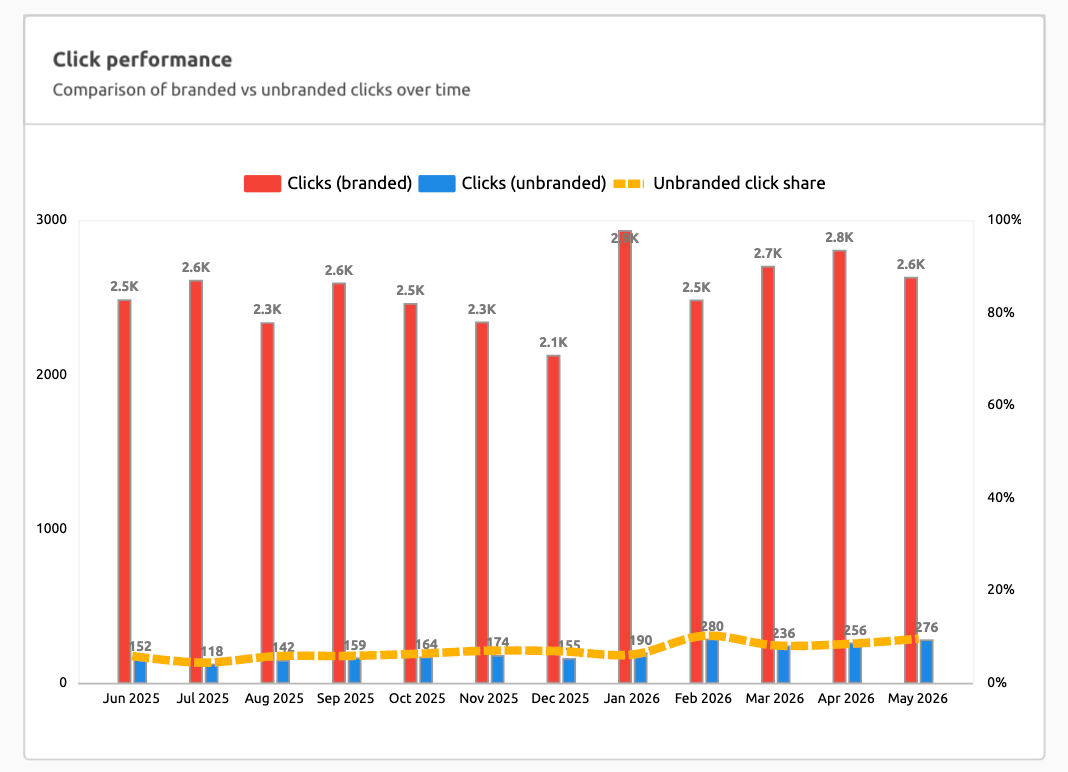
Branded search volume. When more people search your company name, independent of paid brand campaigns, your presence in the market is growing. Les Binet's research at IPA EffWorks 2020 showed that share of branded search is a leading indicator of market share, predicting changes up to 12 months in advance in some categories. Growth in branded search reflects awareness built somewhere, even if you can't trace exactly where. Track this in Google Search Console, and filter out any paid brand campaigns so you're looking at organic branded search only.
In this example, the red bars show branded search volume, and the blue bars show unbranded search volume (new users). You can pull these ad-hoc from Search Console, or set up a report in Looker Data Studio or your favorite BI tool. You don’t need to look at this more than once a month to start.
LLM visibility. A growing portion of B2B research now starts in ChatGPT, Perplexity, or Gemini. If your brand shows up accurately and favorably when someone asks an AI about your category, you're on shortlists that will never appear in your analytics. Check this regularly using the exact queries your buyers would actually type. If you sell security software for mid-market companies, search "best security tools for mid-market SaaS" in ChatGPT and see if you appear, and what it says about you when you do.
There are lots of tools that can help with this. The exact details of the output is a topic for another post, but basically what you need is a set of topics and a percentage tracker, month over month, showing how often you’re mentioned.

Self-reported attribution. A simple open-text field on your demo form, something like "How did you hear about us?", can help capture the podcast someone listened to, the article a colleague shared, the peer recommendation at a conference. Review these responses monthly. Patterns emerge. Maybe three people this quarter mentioned the same podcast episode, or five referenced a competitor comparison post you published six months ago.
Measuring marketing works best when founder and marketer do it together
Accountability matters. Your marketer should be able to connect their work to outcomes and have a clear point of view on what's working and what isn't. You should expect that, not just a report.
But a lot of marketing's impact is invisible, delayed, or impossible to trace to a specific source. Waiting for your marketer to prove ROI with precision before trusting their judgment means holding them to a standard the work can't meet. You'll end up favoring whatever is easiest to measure, which is usually not the same as whatever drives the most growth.
The clearest sign of this trap is when a team cuts content or brand investment because it "doesn't generate leads directly," while keeping paid channels running because the attribution looks clean. Often the content was doing real work: warming up the buyers who later converted through paid, or keeping the company credible in the conversations that preceded every deal. The measurement just couldn't see it.
You know the business outcomes that matter. Your marketer knows the channels and the buyer. Together you're looking for the same clues: pipeline moving, branded search growing, customers mentioning things you made, deals closing faster, inbound quality going up. None of these is a perfect signal. All of them together start to tell a story.
The most useful question you can ask about any metric: what decision does this number actually change? If the answer isn't immediate, you're probably tracking the wrong thing.
If you're interested in what you've read and want to hear more, we're doing an event on June 16th. Register to join us!
Sources
- The 95-5 Rule: Why B2B Marketing Is About Future Demand, LinkedIn B2B Institute — https://business.linkedin.com/marketing-solutions/b2b-institute/the-95-5-rule
- The New B2B Buying Journey, Gartner — https://www.gartner.com/en/sales/trends/the-new-b2b-buying-journey
- Dark Social Makes Google Analytics Worse Than You Think, SparkToro & Really Good Data — https://sparktoro.com/blog/new-research-dark-social-makes-google-analytics-worse-than-you-think/
- Share of Search as a Predictor of Market Share, IPA EffWorks / Les Binet — https://ipa.co.uk/knowledge/publications-reports/share-of-search-as-a-predictor-of-market-share
- Google Analytics 4 Documentation — https://support.google.com/analytics
- Google Search Console Documentation — https://support.google.com/webmasters
- Bing Webmaster Tools — https://www.bing.com/webmasters
- HubSpot Attribution Reporting — https://knowledge.hubspot.com/reports/create-attribution-reports
- Looker Studio Documentation — https://support.google.com/looker-studio
.png)
.png)